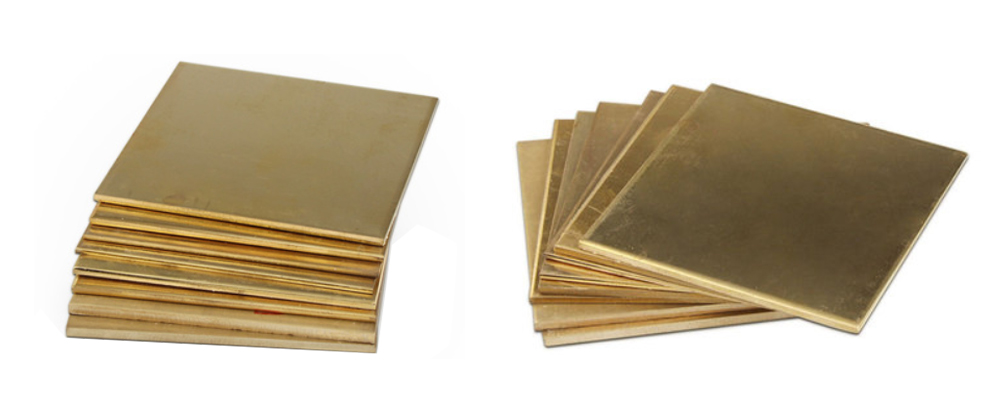
Brass plate is one of the common types of copper in the market. Because of its good plasticity, it is mostly used for various deep-drawing and bending parts, such as gaskets, conduits, heat sink parts, etc.; Brass plates are sometimes used for welding operations during the processing and use of materials. Next, we will introduce the welding method and precautions of the brass plate.
Welding method of brass plate
1. Operation method of electrode arc welding
(1) When using welding rod arc welding to weld brass plates, the welding rod can use bronze core welding rod. If it is a brass casting with low repair welding requirements, pure copper core welding rod can be used.
(2) The power supply adopts DC positive connection, the angle of the V-shaped groove is not less than 60°~70°, and the surface of the material is cleaned before welding.
(3) Short arc welding should be used during operation, and the electrode only moves along the straight line of the welding seam, and does not swing laterally and back and forth. The welding speed is not less than 0.2 ~ 0.3m/min.
(4) If it is multi-layer welding, it is necessary to remove the oxide film and slag between the layers.
(5) Because the copper liquid of brass has high fluidity, the molten pool should be in a horizontal position as much as possible. If it is to be inclined, ensure that the inclination angle is not greater than 15°
2. Operation method of argon arc welding
(1) During manual argon tungsten arc welding, the welding wire adopts tin brass welding wire HSCuZ-1 (HS221), iron brass welding wire HSCuZn-2 (HS222), silicon brass welding wire HSCuZn-4 (HS224), these welding wires contain zinc Higher, the smoke is larger during welding; bronze wire HSCuSi (HS211) and HSCuSn (HS212) can also be used.
(2) When welding brass plates, larger nozzle aperture and argon gas flow should be to alleviate the influence of zinc evaporation on the argon gas protection effect.
(3) The power supply can be connected by direct current or alternating current. When welding with AC power, the evaporation of zinc is small. Welding parameters should adopt larger welding current and faster welding speed. The welding parameters of the 16-20mm thick brass plate are: welding current 260-300A, tungsten electrode diameter 5mm, wire diameter 3.5-4.0mm, nozzle aperture 14-16mm, and argon flow rate 20-25L/min.
(4) In order to reduce the evaporation of zinc, the filler wire and the weldment can be "short-circuited" during operation, and the arc is started and maintained on the filler wire, so as to avoid the arc directly acting on the base metal as much as possible. The base metal mainly relies on the molten pool. Heat transfer of metals to heat and melt. When welding, single-layer welding should be carried out as much as possible, and joints with a thickness of less than 5mm should be welded at one time as much as possible.
Matters needing attention
1. Do a good job of cleaning before welding
No matter which welding method of brass plate is used, the surface of the object to be welded should be carefully cleaned before welding to prevent oil, dirt, rust, scale, etc. from affecting the welding effect or generating gas that is not used for welding work.
2. Ensure a good welding environment
When the brass plate is welded, serious smoke will be generated. Attention should be paid to strengthening ventilation, removing smoke and harmful gases, and ensuring the physical and mental health and personal safety of operators.
3. Post-weld annealing treatment
After the brass plate is welded, the weldment should be heated to 300 ~ 400 ℃ for annealing treatment to eliminate welding stress and prevent the brass components from breaking during use.


